
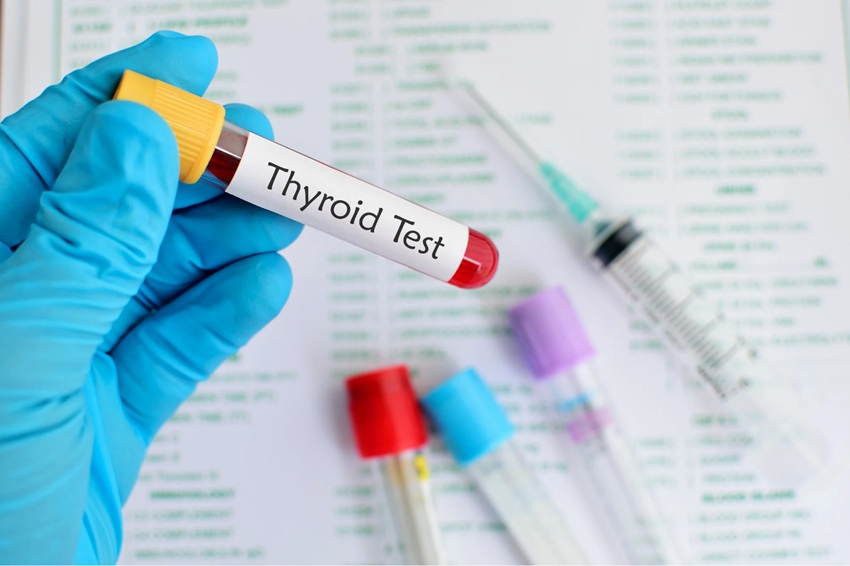
The Three-Pronged Thyroid Model
Function. Autoimmunity. Anatomy.
Most conventional thyroid care focuses almost exclusively on TSH.
That’s like judging engine performance by looking at the fuel gauge.
We don’t do that.
At James Clinic, we evaluate the thyroid as a three-pronged system. Each prong matters, but one of them does the heavy lifting. If you miss it, nothing else works.
Prong One: Thyroid Function
This is the engine. This is what actually moves the mitochondria.
Thyroid hormone is not about passing a lab test.
It is about how much active hormone reaches your cells and what your mitochondria do with it.
This prong answers the most important question in thyroid care:
Is your body actually able to use thyroid hormone at the cellular level?
Why this matters
Thyroid hormone is a master regulator of mitochondrial function. It controls:
- ATP (energy) production
- Heat generation
- Fat and glucose metabolism
- Heart rate and contractility
- Cognitive speed and clarity
If thyroid signaling is impaired, mitochondria downshift. When mitochondria downshift, everything feels harder.
The labs that matter (and why)
Free T3
This is the active hormone.
Free T3 is what enters cells and tells mitochondria how fast to run.
Low or suboptimal Free T3 is associated with:
- Fatigue that doesn’t resolve with sleep
- Cold intolerance
- Brain fog
- Exercise intolerance
- Weight gain despite effort
You can have a normal TSH and normal Free T4 and still have inadequate Free T3 at the tissue level. When that happens, patients feel hypothyroid because they are, functionally.
Reverse T3
Reverse T3 is the metabolic brake.
It increases in response to:
- Chronic stress
- Inflammation
- Illness
- Caloric restriction
- Overtraining
- Trauma
Reverse T3 competes with T3 at the receptor level. When it is elevated, it blocks thyroid hormone action even when blood levels look “normal.”
This is one of the most common reasons patients say:
“My labs are normal, but I feel awful.”
Ignoring reverse T3 means missing stress-induced hypothyroidism entirely.
TSH
TSH is not a thyroid hormone.
It is a pituitary signaling hormone.
It tells us:
- What the brain is asking the thyroid to do
It does not tell us:
- What is happening inside cells
- How well mitochondria are functioning
- Whether hormone conversion is impaired
TSH provides context, not answers.
Why function is the meat of thyroid care
If thyroid hormone cannot:
- Convert properly
- Reach the cell
- Bind the receptor
- Activate mitochondria
…then treating anatomy or autoimmunity alone will never resolve symptoms.
This is why thyroid function testing is where patients finally feel heard and understood.
Prong Two: Autoimmunity
This is where inflammation destabilizes the system.
Autoimmune thyroid disease, most commonly Hashimoto’s, is one of the most under-recognized contributors to thyroid dysfunction.
This prong asks:
Is inflammation and immune attack interfering with thyroid function?
Autoimmunity:
- Often begins years before abnormal TSH
- Creates fluctuating thyroid hormone levels
- Impairs T4-to-T3 conversion
- Drives up reverse T3
You can replace hormone perfectly and still struggle if inflammation is actively disrupting signaling.
Autoimmunity doesn’t replace functional testing.
It explains why function is impaired.
Prong Three: Anatomy
Structure still matters — even when labs look fine.
Blood tests tell us how the thyroid behaves chemically.
They tell us nothing about physical structure.
This prong asks:
Is there a structural issue contributing to dysfunction?
We look for:
- Nodules (hot or cold)
- Fullness or enlargement
- Thickness or asymmetry
- Masses or irregular architecture
Structural findings can:
- Alter hormone output
- Create autonomous hormone production
- Change treatment decisions
- Signal disease progression
Anatomy doesn’t replace function.
It contextualizes it.
Why the One-Lab Model Fails Patients
When thyroid care stops at TSH:
- Functional hypothyroidism is missed
- Stress-induced thyroid suppression is ignored
- Autoimmune disease is delayed or dismissed
- Patients are told symptoms are “not thyroid”
Meanwhile, mitochondrial output drops, inflammation rises, and quality of life erodes.
That’s not cautious medicine.
That’s incomplete medicine.
The James Clinic Thyroid Philosophy
We start with function, because function drives energy.
Then we evaluate:
- Immune interference
- Structural contributors
And we treat based on:
- Symptoms
- Physiology
- Cellular performance
Not just reference ranges.
The Bottom Line
The thyroid is not a single lab value.
It is:
- A functional signaling system
- An immune target
- A physical organ
But function is the driver.
If thyroid hormone is not reaching and activating your mitochondria, the system will never feel stable no matter how “normal” your labs look.
At James Clinic, we don’t balance numbers.
We restore function.