
A tick bite, a fever in a camper at 80°, and the protocol I trust when I’m the patient.
I rarely get sick.
I spent years in trauma and critical care, and the last several helping people get out of the medical system and into actual healing. So when something takes me down, I notice.
Two weeks ago, a tick took me down.
Here’s exactly what happened — and exactly what I’d want you to do if it happens to you.
The Sequence
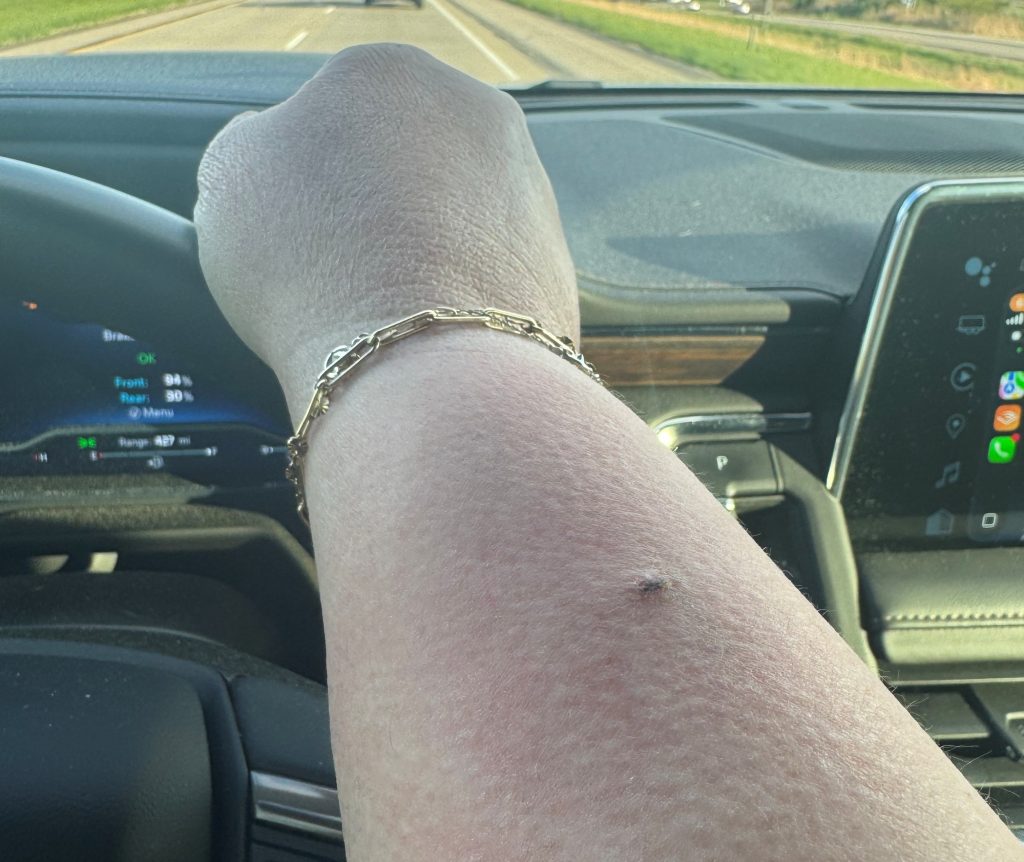
I’ve been pulling ticks off the dogs almost every walk this season. It’s been one of those years. So when I woke up with a red, swollen bite on my right forearm, I didn’t wait.

Day one. Red, swollen, and not waiting to find out.
I started doxycycline that morning and drove to our Chariton office. First treatment: a Major Auto-Hemotherapy (MAH) paired with an IV nutrient infusion — ozone, UV blood irradiation, hydration, and targeted micronutrients. Aggressive immune support, right out of the gate.
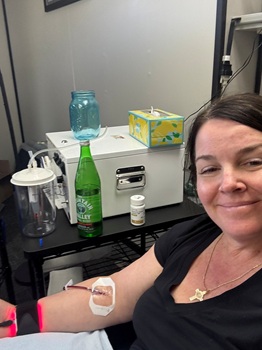
First MAH at our Chariton office. When you’re the doctor, you don’t wait for permission to be aggressive.
The next morning, my arm was worse. More swollen. The redness was expanding outward — the sign you don’t want to see. I looked closer, and there it was: the head of the tick, still embedded in my skin. One of my colleagues dug it out. Second infusion that day.
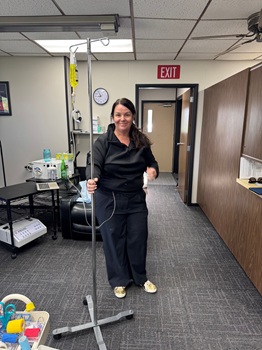
After the head came out. The redness was still expanding — and the fever was coming.
That night, the fever hit. Hard.
Chills so violent I couldn’t get warm. My brother got the camper’s heat working and brought me an electric blanket. I cranked the thermostat to 80° and still shook. I added ivermectin and Pepcid as an anti-inflammatory stack to bring the fever down. It finally broke around 2 or 3 AM.
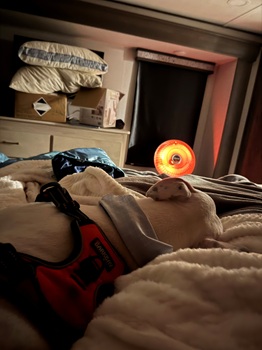
80°, an electric blanket, and a very patient dog. This is what knocked-down looks like.
I woke up in a fog. Brain slowed to a crawl. Fatigue I couldn’t push through. I cancelled my morning patients — something I rarely do — and dragged myself into the office for an EBOO treatment.
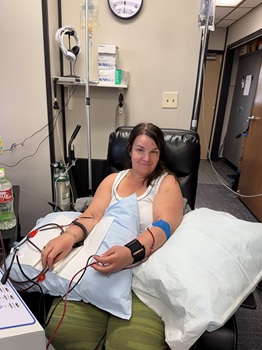
EBOO day. Nearly half the blood volume cycled through oxygen and ozone, with UV blood irradiation.

Where the work happens
The rest of that day was sluggish. Brain still foggy. But the shift was already in motion.
Saturday morning, I woke up at 100%.
The Protocol I Run
Not everyone responds to a tick bite the way I did. But ticks are everywhere this season, and the people who get hit hardest are almost always the ones who waited. If you have a red, swollen bite — or you suddenly feel like you have the “summer flu” — don’t wait. Be aggressive.
Here’s the order I run it in:
- Start doxycycline. Don’t wait for testing. Don’t wait three days to see how you feel.
- Get an MAH. Major Auto-Hemotherapy combines IV ozone with UV blood irradiation and an IV nutrient bag. It supports the immune system and the body’s response to bacterial and viral exposure.
- If MAH alone isn’t doing it, escalate to EBOO. EBOO cycles nearly half of your blood volume through oxygen and ozone, includes UV blood irradiation, and helps break up the stuck, clumped blood that comes with this kind of inflammatory hit.
- Pepcid and ivermectin for anti-inflammatory support and fever management. That combination broke my fever when nothing else was working.
- Vitamin D 50,000 IU daily. Immune support.
- Transfer factor. Additional immune support.
- Herbal antimicrobial tonics. BLT — Bartonella Lyme Tonic — is one of the regulars in my rotation.
This is the protocol I trust because it’s the one I run on myself, my family, and the patients who come to us asking for a different approach than “go home and wait.” What worked for me won’t look identical for you. Every case is different — that’s the whole point of personalized care.
The 20% You Don’t Hear About
Roughly one in five people treated for Lyme go on to develop persistent symptoms — fatigue, brain fog, joint pain, the long tail. For patients in that category, we run a similar aggressive supportive protocol and layer in TruDOSE™ PRP to support immune function. When fatigue is the dominant feature, we add our MitoRegen™ Therapy for cellular energy support.
This isn’t a one-and-done conversation. Tick-borne illness is real, it’s under-recognized, and it deserves a real protocol — not a brush-off.
The Bottom Line
Less than 72 hours from “knocked out by chills in a camper” to back at 100%.
That’s not because I’m tougher than the average patient. It’s because I had the protocol ready, the tools on hand, and a team that doesn’t wait around.
If a tick bites you this summer and something feels off — don’t wait. Be aggressive. Be precise. Be early.
If you don’t have a clinic that takes this seriously, we do. That’s exactly why The James Clinic exists.
Dr. Mollie James, DO, MPH, IFMCP is a board-certified integrative medicine physician and the founder of The James Clinic.
This article is clinical reflection and personal experience, not medical advice. Tick-borne illness treatment should be managed with a physician. The protocols described — including doxycycline, ivermectin, MAH, and EBOO — are clinical interventions that require physician oversight. If you have a tick bite or symptoms consistent with tick-borne illness, see a physician promptly. Do not self-prescribe based on this article.